Clinical Evidence

EndoAngel is backed by peer-reviewed research published in the world’s leading gastroenterology journals.

>95%

Polyp Detection
Sensitivity

+15%

ADR Improvement
in RCT

<40ms

Inference
Latency

10+

RCT & Clinical
Studies

EndoAngel can accurately detect focal lesions and diagnose gastric neoplasms by white-light endoscopy

Focal Lesions Gastric Neoplasms
Internal test External test Internal test Prospective test
Accuracy 93.7% 93.3% 88.8% 92.4%
Sensitivity 96.9% 95.6% 92.9% 91.7%
Specificity 90.6% 90.8% 88.0% 92.4%
Positive predictive value 91.1% 92.2% 61.3% 25.2%
Negative predictive value 96.7% 94.8% 98.4% 99.8%

EndoAngel showed sensitivities of 92.9% (internal data) and 91.7% (external) in diagnosing gastric neoplasms. In prospective tests, it detected focal lesions with 92.8% sensitivity and diagnosed neoplasms with 92.4% accuracy, 91.8% sensitivity and 92.4% specificity. Its clinical potential is highlighted in efficiently screening for suspicious lesions and tumors during endoscopy.

Reference: Wu L, Xu M, Jiang X, et al. Real-time artificial intelligence for detecting focal lesions and diagnosing neoplasms of the stomach by white-light endoscopy (with videos). Gastrointest Endosc. 2022 Feb;95(2):269-280.e6. IF = 6.7

Withdrawal time meets standards under ENDOANGEL assistance
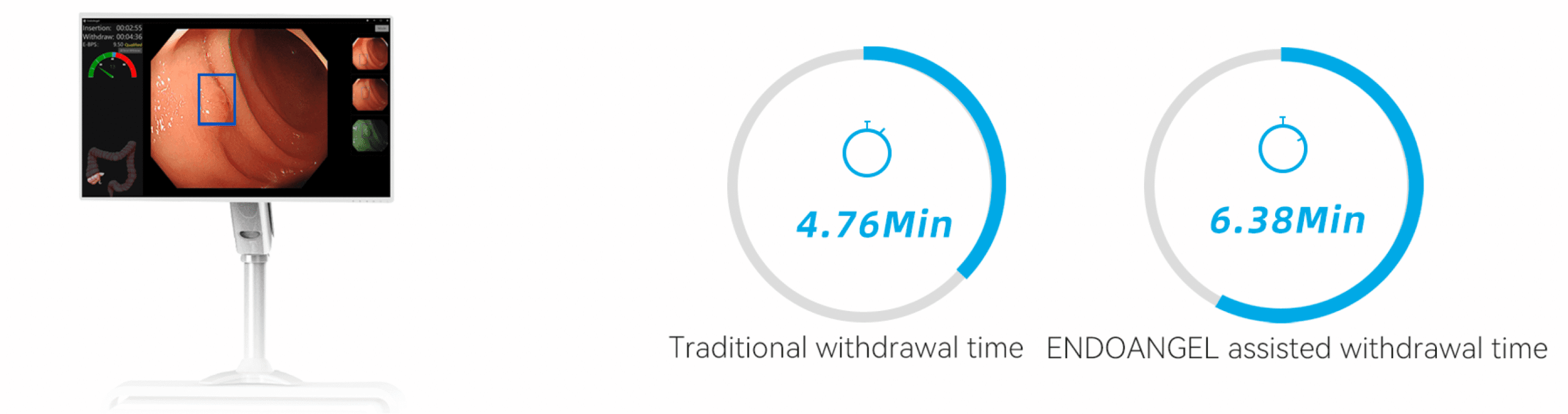
ENDOANGEL withdrawal time comparison

The speed monitoring system included in ENDOANGEL ensures more standardized endoscopic procedures: normal speed 0–40, warning speed 40–44, dangerous speed >44. Previous studies reported that the average withdrawal time in colonoscopies was significantly longer with ENDOANGEL assistance (6.38 min vs 4.76 min), ensuring the integrity and standardization of the procedure.

Reference: Gong D, Wu L, Zhang J. Detection of colorectal adenomas with a real-time computer-aided system (ENDOANGEL): a randomised controlled study. The Lancet Gastro & Hepato. Jan22, 2020. IF=30.9

With ENDOANGEL assistance, polyp and adenoma detection rates are improved
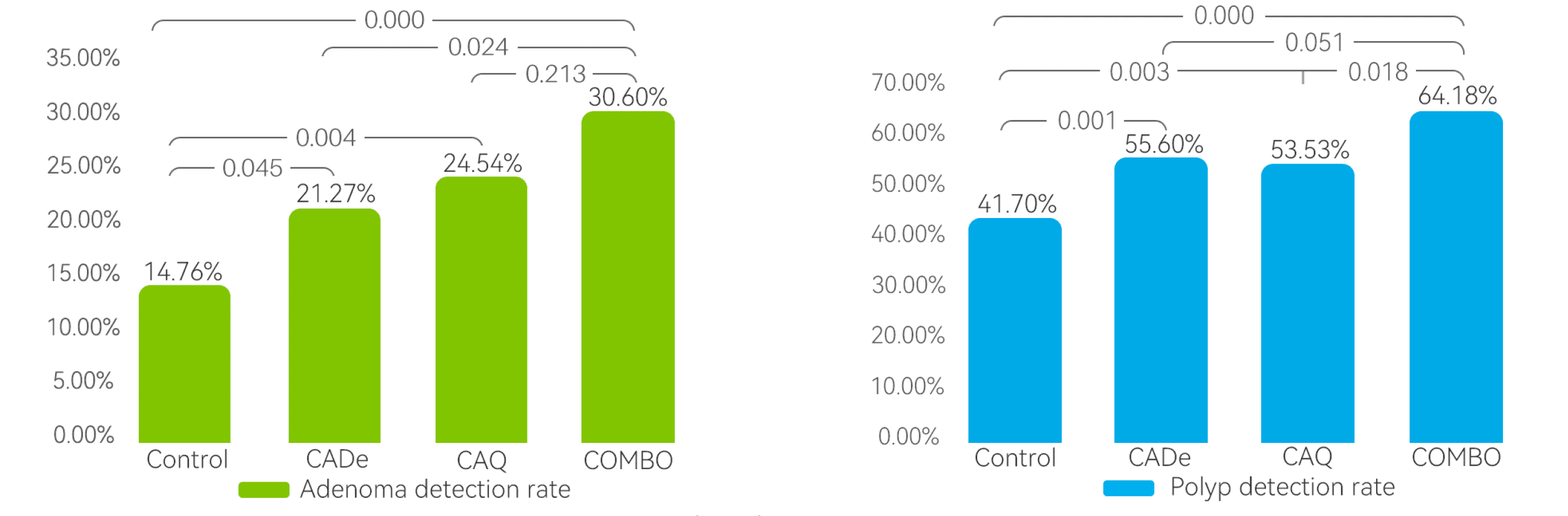
ENDOANGEL ADR PDR detection rate chart

Results showed that using the CADe system, adenoma detection rate (ADR) increased from 14.76% to 21.27%, and polyp detection rate (PDR) increased from 41.70% to 55.60%. Using the CAQ system, ADR increased to 24.54%, PDR increased to 53.53%. Based on this study, the CAD system equipped with CAQ raised ADR to 30.6% and PDR to 64.18% without increasing withdrawal time — further ensuring the quality of colonoscopy examinations and improving lesion detection rates.

Reference: Yao L, Zhang L, Liu J, et al. Effect of AI-based quality improvement systems on computer-aided detection efficacy in colonoscopy: a four-group parallel study. Internal review. Nov 25, 2021. IF=11.5

Published Studies

Colonoscopy

Effect of a deep-learning computer-aided detection system on adenoma detection during colonoscopy (ENDOANGEL): a randomised controlled trial

Lancet Gastroenterology & Hepatology / Gut

Prospective, randomized controlled trial — EndoAngel significantly improved adenoma detection rate (ADR) by ~15% vs. standard colonoscopy.

AI quality improvement system for colonoscopy: a four-group parallel study

Multi-center validation study

Multi-center validation of quality improvement capabilities with consistent performance across different operators and clinical settings.

Upper GI (EGD)

Randomised controlled trial of WISENSE for real-time quality improvement of gastric endoscopy

Lancet Gastroenterology & Hepatology

Significantly reduced blind spot rate during EGD. Achieved near-complete coverage of 26 anatomical stations (p<0.001).

Deep neural network improves endoscopic detection of early gastric cancer

Gut

AI-assisted detection showed superior sensitivity for early-stage gastric cancer identification.

EUS (Endoscopic Ultrasound)

Deep-learning-based pancreas segmentation and station recognition system in EUS

Peer-reviewed multi-center study

Validated accuracy for real-time pancreas boundary delineation. Assists both experienced and trainee endoscopists.

Deep-learning-based bile duct annotation and station recognition in EUS

Multi-center validation study

Automated common bile duct identification and tracking. Supports systematic EUS examination workflow.

Interested in the Full Research?

Contact us for the complete publication list or to discuss clinical collaboration.